

Choosing the right label roll size is the first step before you print the labels; it is as important as selecting the right label material. Labels can be supplied as individual sheets or rolls, but they are most commonly sold in rolls because the roll format offers greater labeling efficiency and is easier to transport and store.
In this beginner’s guide, we will walk you through how to measure a label roll and explain some specifications you may never have noticed. By the end, you’ll get to know what measurements matter for the labels and how to choose the right label roll for your application.
How to Measure Label Roll Dimensions?
Measuring a label roll is quick and easy. Here are the key measurements you need to take – and it’ll take you less than a minute to finish it.

1. Label Width (W)
Label width, sometimes called the “width across”, refers to the horizontal distance from one edge of the label to the other. Please note that you only need to measure the printable area (facestock) of the label; the liner or base paper is not included in the label width.
The common label widths are 30mm, 38mm, 40mm, 50mm, 57mm, 60mm, 75mm, 80mm, 90mm, 100mm, etc. The label width of more than 100mm is usually defined as “wide format labels”.
2. Label Height (H)
The label height measurement is similar to the label width; the only difference is that width is the horizontal measurement, whereas height is the vertical measurement. For example, if a label roll size is 100mm x 50mm, 100mm is the width, and 50mm is the height.
The common label heights are 20mm, 25mm, 30mm, 40mm, 50mm, 60mm, 70mm, 80mm, 90mm, 100mm, 120mm, 150mm, etc.
3. Label Gap (G)
The gap is the empty space between two adjacent labels. The reason why the label has such a gap design is that as light passes through the gap, the gap sensor (or transmissive sensor) from the label printer can detect changes in the amount of light, allowing the printer to identify where one label ends and the next begins.
The most common label gap distances are 2mm and 3mm.
4. Core Size (C)
The label rolls are wrapped and printed around a paperboard or plastic core tube. The core size refers to the inside diameter (ID) of the tube. If the core is too large or too small, the label rolls cannot print properly inside the printer.
The common core tube sizes for label rolls are:
| Core Size | Printer Type |
|---|---|
| 1″ (25 mm) | Portable & handheld printers for small volume printing |
| 1.5″ (38 mm) | Most desktop printers for general label printing |
| 3″ (76 mm) | Industrial printers for high-volume label printing |
5. Label Count (Number of Labels per Roll)
The number of labels per roll is an easily overlooked factor. As the name suggests, it refers to the number of labels that can be wrapped around a core. Label count determines how long the label roll is and how often you need to replace it on your printer.
The general label counts are 500, 800, 1,000, 1,200, 1,500, and 2,000 labels per roll, depending on the label size and printer application.
6. Winding Direction
The roll winding direction indicates how label rolls are oriented on a core. This is also an important specification because different label printers typically use different feeding directions.
- Wound Out (Face Out): It means the printable side of the labels faces outward, and the liner faces inward. Most desktop and industrial label printers use “wound out”.
- Wound In (Face In): The printable side of the labels faces inside, and the liner faces outside. Some special printers and automatic labeling systems use “wound in”.
In addition to the basic label roll measurements above, there are several other specifications you may pay attention to. Understanding them can help you avoid mistakes and ensure you choose the perfectly compatible labels for your application.
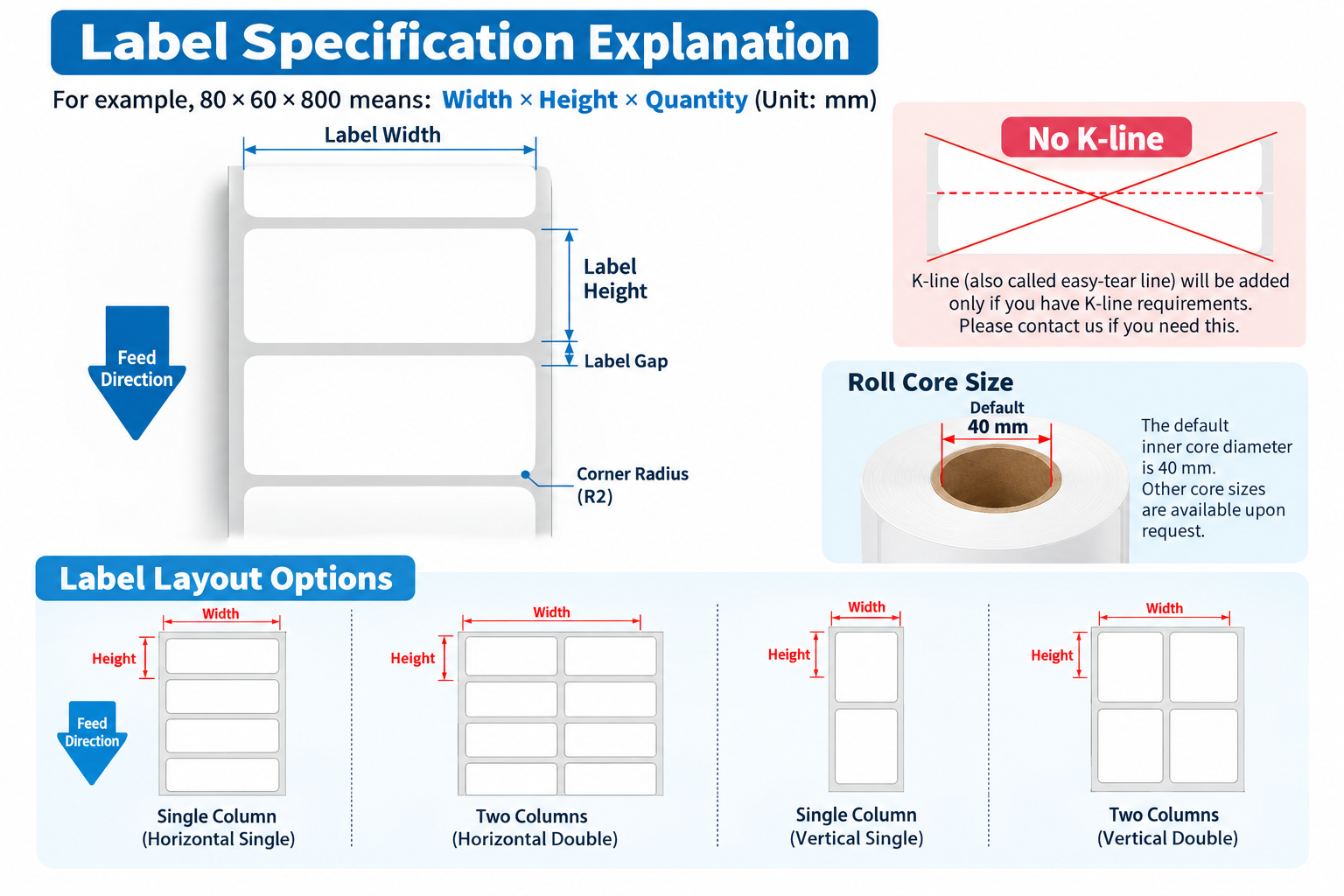
Label specifications explanation (Click to view full size)
| Specification | Why It Matters |
|---|---|
| Outer Diameter (OD) | The outer diameter of the whole label roll across the core tube. Determines whether the roll fits inside your printer. |
| Label Roll Length | The total length of the unfolded label roll. Longer rolls require fewer roll changes and ensure uninterrupted printing. |
| Side Margins | The left and right margins between the edge of the facestock and the edge of the liner. Usually 1 mm or 1.5 mm. |
| Perforation | Small dot lines or holes between individual labels. Allows labels to separate easily after printing. |
| Corner Radius (R) | The roundness of the label corners. It affects the label appearance. |
| Label Shape | The shape of the individual label can come in square, rectangular, circular, oval, or others for different needs |
How to Describe A Complete Label Roll Size?
Now that we’ve learned the key measurements of a label roll, we can put everything together to describe its complete dimensions. In general, a label roll size can be defined by four primary measurements:
For example, a typical label roll dimension is:

Label Dimension: 100mm x 150mm x 500 labels x 76mm core
It means:
- Label Width: 100 mm
- Label Height: 150 mm
- Label Count: 500 labels per roll
- Core Size: 76 mm
In some cases, such as when you have strict requirements for the labels, you may also need to specify additional details, as mentioned above, such as the gap, outer diameter (OD), corner radius, label shape, and other specifics. The more details you provide, the more perfect the products you can get.
What Are the Common Label Roll Sizes?
From tiny jewelry labels to standard carton labels to large-format chemical drum labels, labels come in a wide variety of sizes for different purposes. However, in our experience, some popular label dimensions are still used across different industries.

The table below lists some common label dimensions used worldwide.
| Label Size | Common Applications |
|---|---|
| 30 x 20 mm | Small barcode labels, jewelry labels |
| 38 x 25 mm | Small price labels |
| 40 x 30 mm | Product identification labels |
| 50 x 25 mm | Retail price labels |
| 60 x 40 mm | Inventory and warehouse labels |
| 80 x 50 mm | Carton and packaging labels |
| 100 x 100 mm | Product packaging labels |
| 100 x 150 mm | Standard shipping and logistics labels |
Need Help Choosing the Right Label Roll Size?
By now, we think you know how to measure the label roll size. By taking this information into consideration when choosing your label roll, you can avoid the issues associated with mis-sized rolls for your application equipment.
If you’re still unsure which label roll size is right for your business or which label material you should choose, don’t worry – we’re here to help. Our expert team from Panda Paper Roll will help you determine the correct label roll type & sizes and bring up the best solution. As an experienced label roll manufacturer in China, Panda Paper Roll produces a wide range of custom labels in any size, material, and configuration. Feel free to contact Panda Paper Roll today for free samples or quotations. We are available to serve you at any time.


 WhatsApp Us