

In the medical industry, precise and accurate measurements are not optional; they are a must. That’s why doctors and nurses rely on ECG paper to record the electrical activity of the heart. The electrocardiogram, or ECG, is a vital diagnostic tool that healthcare professionals use to assess heart function. While the technology behind the ECG has changed (and improved) considerably over the years, the basic principles remain the same.
This blog post will discuss everything you need about ECG paper, including its use, how it works, and where to buy it. We’ll also explain why quality matters when choosing ECG paper and other additional information when choosing suppliers. Let’s get started.
What Is An ECG?

An ECG, also known as an electrocardiogram, is a test that measures the electrical activity of your heartbeat. A normal heart produces a specific electrical impulse pattern that makes the heart muscle contract, and this electrical activity can be measured by electrodes placed on the skin’s surface.
An ECG provides important information about the structure and function of your heart. It can detect various heart conditions, including arrhythmias, heart attacks, and cardiomyopathies. An ECG monitors the effects of medications or medical procedures on the heart. It’s a safe and painless test that can provide valuable information about your heart’s health.
What Is An ECG Paper?

ECG paper (also called ECG recording paper, CTG paper, medical heart test paper, cardiology paper, or fetal monitoring paper) is a readout of your heart’s electrical activity on paper.
The paper is made from medical-grade thermal paper and is marked with small, regular square lines corresponding to specific time intervals. These lines help your doctor track and interpret your heart’s tiny electrical impulses, which are constantly generated. The paper is usually attached to an electrocardiograph machine, which amplifies and records these electrical signals. The device then displays them on a screen or printout for your doctor to review.
An ECG paper can provide valuable information about your heart’s health and function and help your doctor diagnose problems such as arrhythmias, heart attacks, and other cardiac conditions. In some cases, it may also monitor your heart’s response to treatment.
How to Read an ECG Paper?
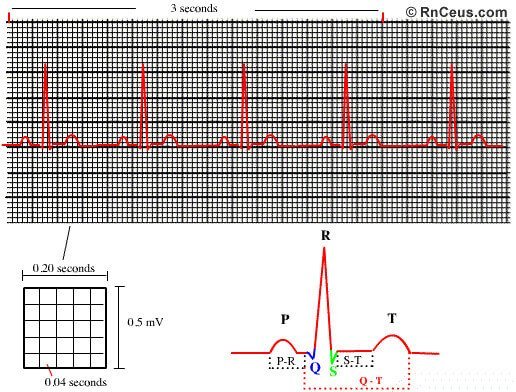
Source: rnceus.com/ekg/ekghowto.html
Reading an ECG paper can be complex. It requires significant training and experience, so always consult a qualified healthcare professional for decision-making. This article will only explain some basic details for you to understand.
- ECG Grid: Each small square on the ECG paper represents 0.04 seconds (40 milliseconds) horizontally and 0.1 mV vertically. Five small squares make up one large square, which represents 0.2 seconds (200 milliseconds) horizontally and 0.5 mV vertically.
- Leads: An ECG is recorded using multiple leads, each providing a different view of the heart’s electrical activity. The standard 12-lead ECG includes limb leads (I, II, III, aVR, aVL, aVF) and chest leads (V1-V6).
The ECG has three primary purposes: to determine the rate, rhythm, and abnormalities of the electrical impulses passing through the heart. Since this is not a scientific article, we will not introduce more detailed information about reading an ECG paper. If you want to learn more, you can check out the article How to Read an ECG.
Why Do We Still Use ECG Paper in the Digital Age?
Despite the rise of digital technologies, ECG paper remains widely used in medical and healthcare settings for several reasons:
- User Habit: Many clinicians are more comfortable interpreting ECGs on paper, where they can see the waveform in a familiar and precise format.
- Reliable Backup: ECG paper doesn’t rely on digital systems, which can fail due to power outages, software issues, or hardware malfunctions. This makes ECG paper a reliable backup in various situations.
- Easy to Share: ECG paper can be easily handed over to other healthcare providers without the need to worry about digital compatibility or file transfer issues.
- Legal Purposes: ECG paper can be easily stored in patient files, providing a tangible record for legal documentation and future reference. Additionally, ECG paper is typically signed and dated by healthcare providers, offering a level of authentication that digital files may lack. This can be especially important in legal cases or when reviewing a patient’s historical data.
- Regulatory Requirements: In some countries and regions, there are regulatory requirements for maintaining hard copies of certain medical records, including ECGs.
What Should You Consider When You Order ECG Paper?
1. ECG Paper Size and Format

ECG paper Source: Panda Paper Roll
The ECG paper size is a crucial factor in ensuring accurate and reliable interpretation of electrocardiogram recordings because it affects both the waveforms’ tracing and readability. The smaller the paper, the more difficult it is to read the tracing accurately. In addition, smaller paper sizes result in a lower tracing amplitude, making it more difficult to identify subtle changes in the waveform.
ECG paper comes in various sizes in the market, but it usually comes in two types and formats:
- Rolls: Paper wound in roll format. They are mostly used in some types of ECG machines that continuously print the results.
- Z-Fold: Also called fan-fold, they are pre-cut sheets of paper in continuous folding format. It is also a common format for ECG paper.
In general, though, some mainstream ECG paper sizes are primarily used in the market. Manufacturers like Panda Paper Roll can offer the ECG paper sizes as per the customer’s specifications and requirements.
| 50mm x 20m Roll | 110mm x 30m Roll | 110mm x 100mm Z-fold |
| 80mm x 20m Roll | 210mm x 20m Roll | 112mm x 100mm Z-fold |
| 80mm x 30m Roll | 210mm x 30m Roll | 210mm x 140mm Z-fold |
| 110mm x 20m Roll | 216mm x 20m Roll | 210mm x 300mm Z-fold |
2. ECG Paper Quality
ECG paper is one of the most essential consumables in an ECG machine, as it is the medium on which the heart’s electrical activity is printed. Therefore, it must be of high quality to provide accurate and reliable waveform recordings. The main factor determining the quality of ECG paper is its weight or density.
This refers to the mass per unit area of the sheet and is usually expressed in grams per square meter (g/m²). A higher density paper is generally of better quality as it produces sharper and clearer terminal deflections.
In addition, they are less likely to fray or curl at the edges, which can lead to artifacts on the tracing. Another important factor to consider is the opacity of the paper, as this affects the visibility of any overlapping waveforms.
3. Paper Compatibility
Compatibility is one of the most important factors to consider when buying an ECG paper. After all, if the paper doesn’t work with your device, it will not do you much good.
There are a few different things to keep in mind regarding compatibility. First, you need to make sure that the paper is compatible with the brand and model of your ECG machine. While most papers will work with any device, there will always be exceptions. If you’re unsure whether a certain paper will work with your machine, it’s always best to follow the ECG machine’s manual or consult with the after-sales support service.
Here, we list some well-known ECG/EKG machine brands that are recognized in the global market:
- GE Healthcare
- Philips Healthcare
- Siemens Healthineers
- Burdick
- Fukuda
- Nihon Kohden
- Mortara
- Mindray Medical
- Bionet
4. Price
Most people looking to buy an ECG paper will have a budget in mind. However, it’s important to remember that price is not the only factor when choosing a paper. While a lower-priced paper may save you money upfront, it may not be as high-quality as a more expensive option.
This can result in inaccurate readings or even damage to your ECG machine. In contrast, a higher-priced paper may be more durable and accurate, ultimately saving you money in the long run. So when considering the price, balance it with other essential factors like quality and durability. Doing so can ensure you’re getting the best value for your money.
Purchase High-Quality ECG Paper from Panda Paper Roll

As the leading ECG paper manufacturer and supplier, Panda Paper Roll has been supplying high-quality ECG paper to thousands of hospitals, medical professionals, and clinics worldwide for over twenty years, and we can provide the paper at affordable wholesale prices.
Our comprehensive product line covers a wide range of formats to fit different printer configurations, and our papers are available in rolls or z-fold boxes, blank or with gridlines If you’re looking for high-quality ECG paper in different sizes, don’t hesitate to contact us for assistance.


 WhatsApp Us
Price for 216*20 ECG paper roll
thank you for this information it is very helpful , this information will help me get better ECG papers.
hey what is the stability studies report of ecg paper? and how it is manufactured?
Does this Healthible Rolls ECG Paper (found at https://www.amazon.com/Machine-Millimeters-Meters-Thermal-Recording/dp/B08XK38SR1) compatible for use with Philips ECG Machines
Very informative article. I have learned a lot about ECG paper. Thanks for sharing.